 <
<
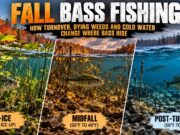




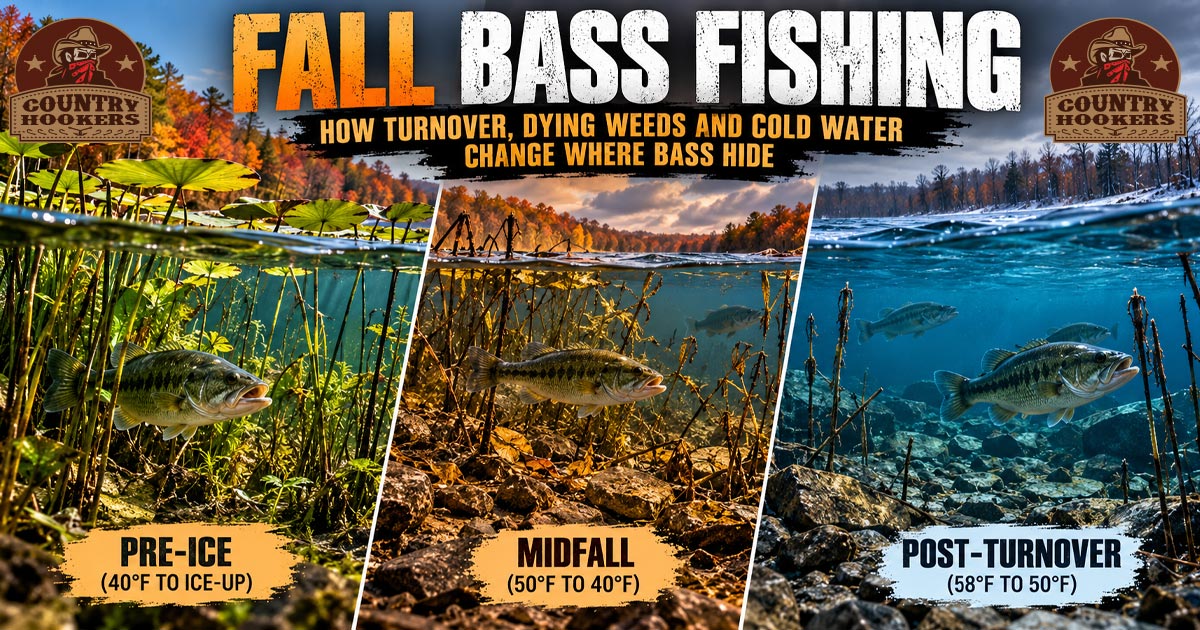
Understanding the three stages of fall bass fishing, where to find fish as the water cools, and how to adjust your lures and tactics from early autumn through the first freeze.
Fall can produce some of the best bass fishing of the year. It can also drive experienced anglers absolutely crazy. One weekend, you’re catching largemouth along shallow weed edges and rocky banks. A week later, those same spots seem completely dead. The water looks different, the vegetation is falling apart, and the fish that were feeding aggressively suddenly seem to have disappeared.
They haven’t disappeared. They’ve moved, and understanding why they move is one of the biggest advantages you can have on the water.
As water temperatures fall, lakes undergo a series of changes that affect oxygen levels, water clarity, vegetation, baitfish, and bass behavior. In many northern lakes, the process includes something called fall turnover, when the distinct layers of water that formed during summer begin mixing.
But turnover is only part of the story. The bigger picture involves the gradual collapse of shallow vegetation, the movement of baitfish toward deeper water, and the increasing importance of whatever healthy cover remains.
For anglers, the trick is recognizing which stage of fall the lake is in and adjusting before wasting half the day fishing spots that stopped producing two weeks ago.
What Happens to a Lake During Fall Turnover?
Throughout the summer, many deeper lakes develop three distinct layers of water.
The upper layer, called the epilimnion, is warmed by the sun and mixed by wind. Beneath it sits the thermocline, a zone where water temperature drops rapidly with depth. Below that is the hypolimnion, the coldest layer, which can become depleted of oxygen as summer progresses.
These layers don’t mix easily because water at different temperatures has different densities.
When fall arrives, shorter days and cooler nights gradually chill the surface. As that water becomes denser, it sinks, weakening the temperature difference between the layers. Eventually, wind and continued cooling can mix much of the water column.
This is fall turnover.
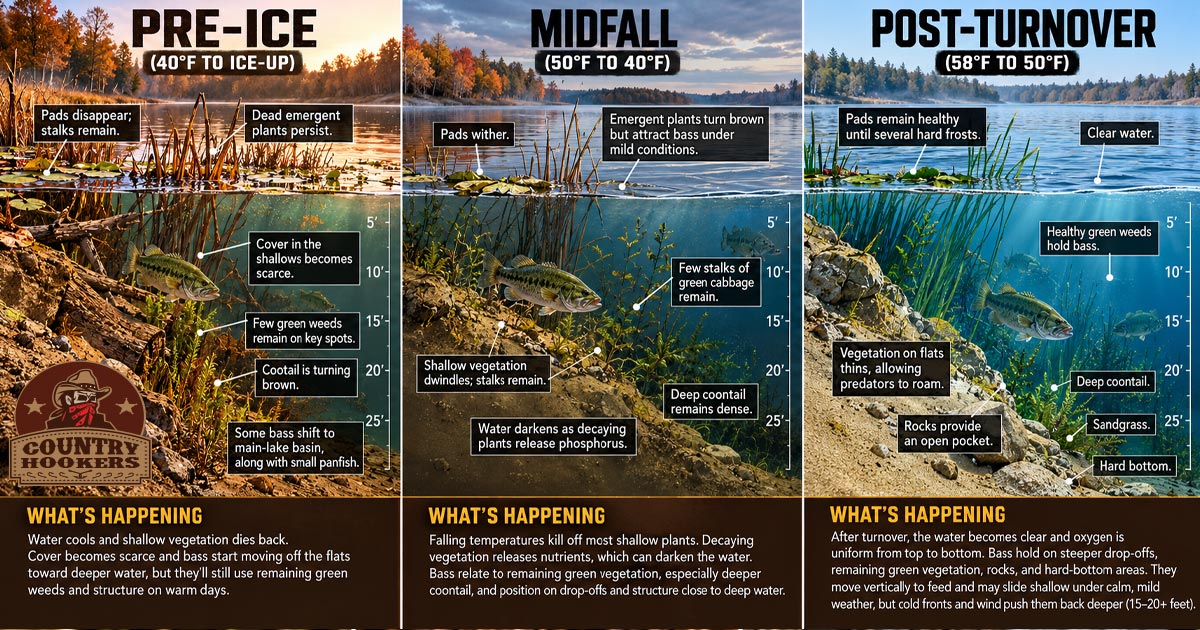
The process can temporarily make fishing difficult. Water clarity may decline, suspended organic material can become more noticeable, and fish may spread out as temperature and oxygen conditions change.
However, turnover does not mean bass stop feeding. It means the conditions that concentrated them in certain locations during summer are changing.
Not every lake experiences turnover the same way. Shallow lakes may remain mixed throughout much of the year, while deep northern lakes often experience a pronounced seasonal turnover. Large reservoirs can also turn over at different times in different arms or basins.
And that matters because the calendar alone won’t tell you what’s happening underwater.
Stage 1: Post-Turnover Bass Fishing (58°F to 50°F)
Water temperatures are approximate seasonal guidelines, not fixed biological boundaries.
This is often one of the more productive periods of fall fishing, particularly in lakes with substantial aquatic vegetation.
The lake has cooled considerably, but much of the underwater plant life is still healthy. Shallow flats may be losing some of their summer vegetation, while deeper weed edges remain green and continue to attract baitfish.
As the shallow vegetation thins out, bass gain more room to roam. Fish that spent summer buried in heavy cover may begin cruising weed edges, rocky transitions, and openings between vegetation patches.
Where to find bass
Focus on remaining green weeds, especially where they meet deeper water. A healthy weedbed in 8 to 15 feet can be particularly attractive if the surrounding shallow vegetation has started dying.
Rock piles, scattered boulders, and hard-bottom openings in weedbeds are also worth investigating. These features give bass places to ambush baitfish without requiring them to remain buried in thick vegetation.
One of the most productive situations is a shallow flat that drops quickly into deeper water. Bass can move up to feed during favorable conditions and retreat without traveling far.
Best lures and presentations
- Spinnerbaits: Cover large areas around thinning vegetation and shallow weed edges.
- Chatterbaits: Work especially well through scattered green vegetation and along hard-bottom transitions.
- Squarebill crankbaits: Bounce them off rock, wood, and isolated cover.
- Swimbaits: Match the size of local shad, minnows, or other forage.
- Jigs: Pick apart rock piles, weed openings, and deeper edges when moving baits stop producing.
Don’t automatically slow everything down just because the water is cooling. Bass can still chase fast-moving baitfish aggressively at these temperatures.
The better approach is to start with moving baits to locate active fish, then slow down around productive cover.
Stage 2: Midfall Bass Fishing (50°F to 40°F)
By midfall, much of the shallow vegetation is beginning to die. Lily pads wither, submerged plants collapse, and the thick weedbeds that held bass during summer can turn into scattered stalks and decaying material.
This is where many anglers get into trouble. They continue fishing the same shallow cover that produced during summer, even though the conditions that attracted bass have disappeared.
Healthy vegetation becomes increasingly valuable because there is less of it available.
Finding the last green weeds
Look for deeper vegetation that hasn’t completely deteriorated. Depending on the lake, this might be coontail, cabbage, or another submerged plant that remains healthy longer than the surrounding weeds.
A small patch of green vegetation can hold a surprising number of fish when most of the lake’s shallow cover has died.
The key isn’t necessarily finding the largest weedbed. It’s finding the healthiest remaining vegetation near access to deeper water.
Bass may also hold around isolated wood, rocky points, and steep banks where they can feed without relying on vegetation.
Why water clarity can change
Decaying vegetation releases nutrients and organic material into the water. In some lakes, this contributes to stained water or fall algae blooms. Wind, runoff, and seasonal mixing can also affect clarity.
Don’t assume that every murky lake is experiencing turnover. Sometimes you’re simply dealing with vegetation decay, sediment, or changing weather.
When visibility drops, bass may rely more heavily on vibration, movement, and nearby ambush cover to locate prey.
Best lures and presentations
Jerkbaits become increasingly effective, particularly when bass are suspending along weed edges or rocky points. A suspending jerkbait with longer pauses can stay in the strike zone without requiring the fish to chase it far.
Lipless crankbaits can be productive around remaining vegetation. Rip them free when they catch the tops of weeds, creating an erratic movement that can trigger reaction strikes.
Football jigs and finesse jigs work well around hard-bottom transitions and rock. Slow down when fish are less willing to chase.
Blade baits are another strong option when bass move onto deeper structure, especially in clearer water.
As temperatures approach 40°F, pay closer attention to retrieve speed. Bass are still capable of feeding, but a lure racing through the strike zone may get fewer bites than one that stays in front of them longer.
Stage 3: Pre-Ice Bass Fishing (40°F to Ice-Up)
This is where fall bass fishing becomes a different game.
By the time water temperatures reach the upper 30s, much of the shallow vegetation in northern lakes has disappeared. Lily pads are gone, shallow weedbeds have collapsed, and only scattered stalks or a few surviving green patches remain.
Bass often become concentrated around steeper structural features that provide access to different depths.
The fish haven’t necessarily abandoned shallow water entirely. They simply become more selective about when they move into it.
Where bass go before ice-up
Steep drop-offs, rocky points, creek channels, and remaining green vegetation near deeper water become prime locations.
In lakes with substantial depth, bass may hold in 15 to 25 feet or deeper, depending on oxygen availability, forage, and local conditions.
Some fish remain relatively shallow, particularly in lakes where deep water offers little advantage. The important thing is identifying where bass can find food and suitable conditions without expending unnecessary energy.
Look for places where a steep break intersects rock, surviving vegetation, or another form of cover.
During mild, calm weather, bass may move shallower to feed. A few days of stable conditions can make a major difference.
Strong cold fronts, falling temperatures, and wind can change where fish are positioned, although these conditions don’t always force bass deeper.
Best lures and presentations
At this point, slower presentations often become more reliable.
- Blade baits: Lift and drop them along steep breaks and rocky bottoms.
- Football jigs: Crawl them slowly through rock and hard-bottom areas.
- Suspending jerkbaits: Use longer pauses, sometimes several seconds or more.
- Ned rigs: Fish slowly around isolated rock, hard-bottom pockets, and deeper structure.
- Drop-shot rigs: Keep a small soft plastic in front of fish holding near bottom or suspended just above it.
- Tailspins and compact spoons: Useful when bass are feeding on small baitfish in deeper water.
A common mistake is assuming cold-water bass won’t bite. They absolutely will, and some of the year’s largest fish are caught during the final weeks before ice-up.
The challenge is finding concentrations of fish and presenting a lure at a speed they’re willing to pursue.
How to Find Bass When Your Favorite Fall Spots Go Dead
One of the biggest mistakes in fall fishing is assuming the fish will remain in the same locations as the season progresses.
A productive September weedbed may be nearly worthless by late October. Meanwhile, an isolated rock pile or a small patch of green vegetation that produced nothing during summer might suddenly hold several quality fish.
The solution is to stop thinking about individual fishing spots and start looking at the features that attract bass.
Follow the baitfish
Bass follow food. That sounds obvious, but it’s easy to overlook when you’re concentrating on vegetation, water temperatures, and depth contours.
During fall, schools of shad, minnows, perch, and other forage fish often change locations as water conditions shift. Depending on the lake, they may gather around creek channels, points, deeper vegetation, or open-water structure.
If you’re marking baitfish on sonar but not seeing bass, investigate nearby breaks, rocks, and cover. Bass may be positioned below or beside the bait rather than directly inside the school.
When fishing without electronics, watch for surface activity, diving birds, and baitfish moving along the shoreline.
Look for the greenest vegetation in the lake
Not all aquatic plants die at the same rate. Some species remain healthy well into late fall, while others deteriorate much earlier.
Green vegetation can provide cover, support aquatic life, and attract forage. That makes surviving weedbeds particularly valuable when much of the surrounding cover has disappeared.
In some lakes, a single healthy patch of cabbage or coontail near a steep drop-off can be more productive than an entire shoreline of dead weeds.
Pay attention to hard-bottom transitions
As vegetation disappears, rock and other permanent structure become easier to identify and more important to investigate.
Rocky points, gravel bars, submerged humps, and boulder fields can attract fish throughout the fall.
Pay particular attention to transitions between bottom types. A gravel patch surrounded by mud, or a rock pile beside a deeper channel, creates a distinct feature that bass may use as a feeding location.
Don’t abandon shallow water
Although many bass move toward deeper structure as winter approaches, some continue feeding shallow throughout the fall.
A sunny afternoon following several days of stable weather can bring fish into relatively shallow water, particularly where rock absorbs solar energy or baitfish are present.
Likewise, stained water and shallow lakes may hold bass at considerably different depths than clear, deep reservoirs.
Use the fish’s behavior to guide your decisions rather than assuming every bass must be in 20 feet of water because it’s November.
Fall Bass Fishing by Water Temperature
| Water temperature | Where to start looking | Lures to try |
|---|---|---|
| 65–58°F | Shallow flats, points, weed edges, baitfish schools | Spinnerbaits, crankbaits, swimbaits |
| 58–50°F | Healthy weeds, rock piles, shallow-to-deep transitions | Chatterbaits, jerkbaits, jigs |
| 50–40°F | Remaining green vegetation, steep breaks, rocky points | Jerkbaits, jigs, lipless crankbaits |
| 40°F to ice-up | Steeper structure, deeper rock, isolated cover | Blade baits, Ned rigs, drop-shots |
These ranges are starting points. Water clarity, forage, lake depth, geographic location, and recent weather can change the pattern considerably.
How Weather Changes the Fall Bite
Fall weather can be unpredictable. A week of mild afternoons can be followed by freezing nights, heavy wind, and rapidly falling water temperatures.
The important distinction is between a single cold day and a sustained change in conditions.
A brief cold front doesn’t automatically send every bass into deep water. Fish may remain near the same structure but become less aggressive, reposition within cover, or feed during shorter windows.
Extended cooling, on the other hand, can gradually change where baitfish and bass spend most of their time.
Stable weather often makes fish easier to pattern. When temperatures and conditions remain relatively consistent for several days, bass may repeatedly use the same feeding areas.
Wind can also improve fishing by pushing baitfish toward points and shorelines and reducing visibility in clear water. But strong wind isn’t automatically beneficial, especially when it makes boat control or lure presentation difficult.
Fishing Natural Lakes vs. Reservoirs in the Fall
Not every body of water follows the same seasonal pattern.
Natural lakes with extensive vegetation often experience noticeable changes as lily pads, cabbage, and other aquatic plants deteriorate. In these lakes, finding healthy weeds can be one of the most important parts of a successful fall pattern.
Reservoirs may have less vegetation and more prominent creek channels, rocky points, standing timber, and submerged roadbeds. Bass in these systems often relate more closely to baitfish movements and permanent structure.
Reservoir water levels can also change dramatically during fall. Drawdowns may expose shallow cover or force fish to reposition.
In either situation, the same principle applies: find the food, identify nearby structure, and pay attention to the changing water conditions.
Five Mistakes That Cost Anglers Fish During Fall
- Fishing dead vegetation. If a once-productive weedbed has turned brown and collapsed, spend more time looking for healthier cover.
- Assuming turnover ruins fishing everywhere. Turnover can affect fishing, but it doesn’t occur uniformly across every lake or necessarily shut down the bite.
- Fishing too fast in cold water. Moving baits still work, but slowing down can make a major difference when fish become less aggressive.
- Automatically heading deep. Bass may move deeper during late fall, but shallow fish can remain active when conditions are right.
- Ignoring baitfish. Beautiful structure doesn’t mean much if there’s no food nearby and no bass using it.
Fall Bass Fishing Is About Finding What’s Left
By late fall, the underwater world looks nothing like it did in July. Shallow vegetation has disappeared, water temperatures have dropped, and baitfish have shifted into different areas of the lake.
For bass anglers, that creates both a challenge and an opportunity.
The fish may no longer be scattered across acres of summer vegetation. Instead, they can become concentrated around the last healthy weedbeds, rocky transitions, and steep breaks that provide reliable feeding opportunities.
Learn to recognize those changes, and you’ll spend less time casting into empty water and more time fishing where the bass have actually moved.
And don’t put the rods away just because the mornings are cold. Some of the best bass fishing of the year happens when everyone else has already winterized the boat.