 <








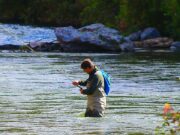
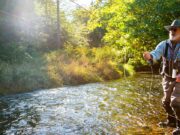




You’re fishing a river you’ve been visiting for years. The bass are biting, you’ve got a good stretch of water to yourself, and then somebody walks down from a nearby house and tells you to get the hell off his property.
He owns the land. Maybe he even owns the riverbed. But does that mean he owns the fish swimming through it?
What about the guy who buys a hundred acres surrounding a lake? Can he tell everybody else they’re no longer allowed to fish there? And if your neighbor stocks his private pond with largemouth bass, does he actually own those fish?
These aren’t just hypothetical arguments between fishermen and angry property owners. Questions about fishing access, private property, and wildlife ownership have been fought over in American courts for generations.
The surprising part is that owning the land, owning the water, owning the fish, and having the right to catch those fish are four different legal questions.
And depending on where you’re fishing, the answers can be very different.
So Who Owns the Fish in a Lake?
In most American public waters, wild fish are considered a public resource managed by the government for the benefit of the people. That doesn’t mean the government owns every individual bass or trout the way somebody owns a truck. It means fish populations are generally protected and regulated under a legal concept known as the public trust.
The U.S. Fish and Wildlife Service identifies wildlife as a public trust resource under the North American Model of Wildlife Conservation.
In practical terms, this is why states can require fishing licenses, establish daily catch limits, impose seasonal closures, and prohibit keeping certain species.
The fish don’t belong exclusively to whoever owns the nearest shoreline.
However, there’s an important catch: public ownership of wildlife doesn’t automatically give you the right to enter private property to catch it.
A landowner may have no exclusive claim to the wild trout swimming through a river, yet still have the legal authority to keep you from crossing his backyard to reach that river.
That’s where fishing rights start getting complicated.
Can Someone Privately Own a Lake and All Its Fish?
Yes, private lakes and ponds exist, and private owners can have exclusive fishing rights in them. But the details depend on the body of water, how it was created, whether it connects to public waters, and the laws of the state.
Consider two very different situations.
Situation one: A farmer digs a pond on his own property. He fills it, purchases hatchery-raised bass and bluegill, and manages it as a private fishing pond. Depending on state law, he may own those stocked fish and control who gets to fish there. Private fish ownership and private-pond exemptions are expressly recognized in some state laws.
Situation two: A developer purchases all the land surrounding a naturally occurring, legally public lake. Owning the shoreline doesn’t necessarily give that developer ownership of the lakebed, the fish, or the right to exclude boaters and anglers who lawfully reach the water.
The Association of Fish & Wildlife Agencies maintains a state-by-state legal research collection showing how differently states handle fish ownership.
The important distinction is whether you’re dealing with a genuinely private fishery or a public waterbody surrounded by private land.
Those aren’t necessarily the same thing.
The River Runs Through Your Property. Can You Keep Fishermen Out?
Imagine buying a beautiful piece of property with a trout stream running straight through the middle. You pay the taxes, maintain the land, and own both banks.
Then one morning you look outside and see three fishermen wading upstream.
Can you kick them out?
Maybe. But not simply because your deed shows that you own the surrounding land.
American water law makes an important distinction between private land ownership and public rights to use certain waterways. Navigable waters have historically received special protection under the public trust doctrine, although states differ in how they define and enforce public fishing access.
In the 1891 Supreme Court case Hardin v. Jordan, the Court examined the distinction between public and private waters and the associated rights of landowners and fishermen. The decision also discussed the traditional rule that ownership of private freshwater beds could carry exclusive fishing rights.
More than a century later, those distinctions still matter.
A river can cross privately owned land while remaining open to certain public uses. But the extent of those uses, including fishing, wading, and touching the riverbed, depends on applicable law.
That’s why a fisherman might legally float through one privately owned stretch of river but face a trespassing violation for stepping onto the bank.
What Does “Navigable Water” Actually Mean?
Here’s where the law gets especially confusing.
When most people hear the word navigable, they picture a river big enough for a motorboat.
But legal navigability isn’t necessarily determined by whether you can launch a bass boat.
Courts have used different tests for different purposes, including historical commercial use and whether a waterway was capable of serving as a route for commerce. States also have their own standards for public recreational rights.
A stream doesn’t automatically become public fishing water just because somebody can float a kayak down it.
Likewise, a river doesn’t necessarily lose its legal status because it becomes shallow during part of the year.
The U.S. Supreme Court has repeatedly recognized the states’ important authority over navigable waters and submerged lands, subject to federal constitutional powers and other applicable rights.
For fishermen, the practical question isn’t just whether a river is navigable. It’s whether state law gives the public the right to fish, float, wade, or use the streambed at that particular location.
And the differences between states can be enormous.
Three States, Three Very Different Approaches to Public Fishing Rights
The easiest way to understand the problem is to look at what happens when the same fisherman crosses state lines.
Montana: The Public Has Broad Stream Access Rights
Montana is one of the better-known examples of strong public stream access protections.
Under Montana’s Stream Access Law, the public can generally use rivers and streams capable of recreational use up to the ordinary high-water mark, regardless of who owns the land underneath.
That includes fishing and other water-related recreation, subject to applicable restrictions.
You still can’t cross somebody’s private pasture or backyard without permission to reach the water. But once you’ve entered a qualifying stream legally, private ownership of the riverbed doesn’t automatically end your right to fish.
Montana also has specific provisions addressing access at public bridges and county road rights-of-way.
These rules apply to qualifying rivers and streams, not automatically to lakes, ponds, and reservoirs.
Source: Montana Fish, Wildlife & Parks — Stream Access.
Texas: The State May Own the Fish, but You Still Can’t Fish Everywhere
Texas offers an especially interesting distinction.
According to Texas Parks and Wildlife, the state owns the water of natural streams and lakes and the fish living in them. But that public ownership does not give fishermen unrestricted access to private lakes and streams.
On legally navigable streams, the public generally has the right to use the streambed, even where certain private property rights exist.
On privately owned, non-navigable streams, fishing or wading can require landowner permission.
Texas also recognizes navigability under a statutory test involving streams averaging 30 feet wide from the mouth upward, alongside other legal standards.
Source: Texas Parks and Wildlife — If a River Runs Through It, What Law Applies?.
Pennsylvania: A Public Trout Stream Might Run Through Private Property
Pennsylvania has a long tradition of landowners allowing fishermen to access streams crossing their property.
But that arrangement is more fragile than many anglers realize.
According to the Pennsylvania Fish and Boat Commission, approximately 83% of the state’s stocked trout waters and 70% of its wild trout waters are located on private lands.
That’s a staggering amount of fishing dependent on property rights and landowner cooperation.
Pennsylvania generally recognizes public fishing rights in legally navigable streams, including where they cross private land. But non-navigable streams can be privately controlled, and landowners can restrict fishing and wading.
Even more interesting, the state says that recreational use alone doesn’t establish legal navigability. Historical commercial use is central to Pennsylvania’s test.
Source: Pennsylvania Fish and Boat Commission — Public and Private Access.
What Happens When Taxpayer-Funded Fish Are Stocked in Private Waters?
Now consider another situation.
Your state wildlife agency raises thousands of trout in a hatchery, loads them into stocking trucks, and releases them into a stream.
The program is supported by public funding, license revenue, and other conservation money.
A few weeks later, the landowner decides he doesn’t want anybody fishing his section of the creek.
Should he be allowed to keep the public away from fish the public helped pay to raise?
It’s a legitimate question, and one that exposes the difference between funding a fishery and securing public access to it.
Pennsylvania provides a particularly useful example.
Under 30 Pa.C.S. Section 2103, waters stocked with fish furnished by the Pennsylvania Fish and Boat Commission must be open for free lawful public fishing. But that provision doesn’t give anglers blanket permission to trespass across private land or damage property.
The Pennsylvania Fish and Boat Commission also reports that increased landowner posting is the leading reason waters are removed from active management programs such as stocking. The agency identifies littering, fires, damage to farm fields, and blocked driveways among the behaviors that cause problems.
This creates an uncomfortable reality for fishermen: access to a productive fishery can disappear because of disputes involving landowners, even when public agencies have invested in improving that fishery.
It also explains why respecting private property isn’t just a matter of courtesy. It can determine whether future generations get to fish the same stretch of water.
If You Catch a Fish, Does It Become Your Property?
Generally, a fish legally caught and retained under applicable fishing regulations becomes something the angler can lawfully possess.
But catching a fish doesn’t automatically mean you can do whatever you want with it.
States regulate which species can be kept, minimum and maximum sizes, daily limits, possession limits, transportation, and whether fish can be sold.
Some species must be released immediately. Others may be subject to special restrictions or permits.
And a fishing license doesn’t grant ownership of fish that are still swimming around in the lake. It authorizes fishing activities under the rules established by the state.
Think about it this way: purchasing a hunting license doesn’t mean you own the deer in the forest. Purchasing a fishing license doesn’t mean you own the bass in the reservoir.
You have permission to pursue and, when legally allowed, take certain wildlife.
That’s very different from owning it before capture.
Can You Fish a Lake Surrounded by Private Property?
This is one of the biggest sources of confusion for fishermen.
Suppose there’s a 200-acre lake surrounded entirely by private homes. The lake has largemouth bass, crappie, and catfish, and satellite imagery makes it look like a fantastic place to fish.
Does the public have the right to get onto the lake?
Not necessarily.
First, you need to determine whether the lake is legally public or private. Second, you need to determine whether there is a lawful public access point.
Even where public fishing rights exist, those rights generally don’t authorize crossing someone’s yard, driveway, or other private property.
A public lake can effectively be difficult to reach when the surrounding land is privately controlled and there is no public launch, access easement, or other lawful entry.
On the other hand, a lake surrounded by private homes may still have public access through a state park, county boat ramp, public road, or legally established easement.
The shoreline doesn’t necessarily determine who owns the fish, but it can determine whether you can reach them.
What About Fishing From a Boat Along Private Docks?
If you’re legally boating and fishing on public water, a waterfront homeowner generally doesn’t acquire exclusive ownership of nearby wild fish simply because those fish gather around his dock.
But you still need to follow applicable fishing regulations, navigation rules, and property laws.
A private dock is not automatically public property. You shouldn’t tie up to it, climb onto it, or use someone else’s equipment without permission.
Local restrictions may also prohibit fishing in particular marina areas, around certain structures, or within designated safety zones.
There’s an important difference between casting toward a dock from lawful public water and physically occupying somebody else’s property.
And if a homeowner tells you that the bass under his dock belong to him, that claim alone doesn’t establish a legal right to exclude you from otherwise lawful public fishing.
Does a “No Fishing” Sign Actually Mean Anything?
Absolutely. But what it means depends on where it’s posted and who has the authority to enforce it.
A sign on a genuinely private pond can indicate that fishing is prohibited without permission.
A sign posted by a government agency at a closed public fishing area can also carry legal consequences.
But a private landowner putting a “No Fishing” sign beside a legally public river doesn’t necessarily have the authority to prohibit fishing in the public waterway.
The sign may lawfully prohibit entering the adjacent private land without affecting public rights in the water.
This is where fishermen need to be careful. A sign can be misleading, but assuming every sign is meaningless is a good way to end up in a trespassing dispute.
Before challenging a posted restriction, check the state wildlife agency’s access guidance and, where necessary, the local land records or relevant legal determinations.
What If You Accidentally Catch a Fish That Escaped From a Private Pond?
Fish don’t recognize property lines.
Heavy rainfall, flooding, and connections between waterways can allow fish to move from one waterbody to another.
Suppose somebody stocks a private pond with expensive largemouth bass, and some of those fish escape into a nearby public creek.
Does the pond owner retain ownership of those particular fish forever?
There isn’t a single nationwide answer.
The result can depend on state wildlife law, whether the fish were legally held as private property, the nature of the waterway, and any rules governing escape or release.
Once fish enter public waters, the applicable public fishery regulations may control whether anglers can catch and retain them. But it would be a mistake to assume that every escaped privately raised fish automatically becomes public property under every state’s laws.
This is another example of why the legal status of fish can be more complicated than the location where they were originally raised.
The Bigger Problem: Public Fish, Shrinking Access
For most fishermen, the real concern isn’t whether the state technically owns a largemouth bass.
It’s whether they’ll still have somewhere to catch one.
Fishing access can be restricted by private development, landowner decisions, changes to public access agreements, and disputes over waterway rights.
And access doesn’t have to disappear through a formal legal prohibition.
A lake without a public boat ramp may be inaccessible to many anglers. A stream with private property along every road crossing can become difficult to reach. A once-welcoming landowner can decide he’s had enough of people leaving trash and parking across his driveway.
The Texas Parks and Wildlife Department operates a leased-access program that works with private landowners to provide public fishing and boating entry points on rivers including the Brazos, Colorado, Guadalupe, and Neches. That’s a practical recognition that public water rights aren’t much use without somewhere to get into the water.
In Pennsylvania, the Fish and Boat Commission has programs designed to encourage voluntary public access and acquire additional fishing opportunities.
The legal right to fish is important. But maintaining actual places where ordinary people can fish is just as important.
How to Find Out Whether You Can Legally Fish a Lake or River
Before heading to unfamiliar water, especially when private property is involved, do a little research.
- Start with your state’s fish and wildlife agency. Look for public fishing access maps, stream access rules, and regulations specific to the waterbody.
- Check for established access points. Public boat ramps, parks, and authorized fishing easements are usually safer options than assuming you can cross an undeveloped lot.
- Don’t confuse a fishing map with permission to enter. A state may list a stream as a fishing destination even when portions run through private property.
- Verify river access rules. Floating, fishing, wading, and using the bank may be treated differently under state law.
- Ask permission when necessary. Many private landowners allow fishing when people approach them respectfully.
- Check special regulations. A waterbody can be publicly accessible while fishing is restricted by season, species, equipment, or other rules.
Most importantly, don’t assume that something you read about Montana, Texas, or Pennsylvania applies to a river in another state.
Frequently Asked Questions About Fish Ownership and Public Fishing Rights
Who owns the fish in a public lake?
Wild fish in public lakes are generally managed as public trust resources under state law. Individual anglers do not own those fish before catching them, and nearby landowners generally cannot claim exclusive ownership merely because they own waterfront property.
Who owns the fish in a private pond?
Fish legally purchased and stocked in a private pond may be privately owned, depending on state law. Private pond owners can also generally control access to their property, subject to applicable water and wildlife regulations.
Can you fish a river that runs through private property?
Sometimes. Public fishing rights depend on state law and the legal classification of the waterway. You may have the right to fish in the river without having the right to cross private land to reach it.
Can a landowner own the riverbed but not control fishing?
Yes. In some states, public recreational rights exist even where portions of the streambed are privately owned. Montana’s stream access rules are a prominent example.
Can a homeowner stop you from fishing near his dock?
Not merely because he owns the dock, if you’re fishing lawfully from public water and no applicable restriction prohibits it. You still cannot trespass onto the dock or interfere with its lawful use.
Does buying a fishing license give you the right to fish anywhere?
No. A fishing license allows fishing under applicable regulations. It does not grant permission to trespass or override private property rights.
Can a private lake become public?
The legal status of a lake can be affected by its history, ownership, public rights, easements, and applicable law. Simply stocking fish or allowing occasional public use does not necessarily convert a private lake into public property.
Nobody Owns Every Fish Just Because They Own the Shore
America’s fishing laws are built around two ideas that don’t always fit neatly together: private property rights and the public’s interest in wildlife and waterways.
A landowner can own both sides of a river without necessarily controlling the public’s right to fish it. A state can manage the fish in a lake without giving anglers the right to cross private property to reach it. And a privately stocked pond can operate under very different rules from a public reservoir.
For fishermen, the most important distinction is simple: the right to catch a fish and the right to get to that fish are not the same thing.
You might have every legal right to catch the bass swimming in front of somebody’s waterfront house. That doesn’t mean you can walk across his lawn to do it.
And the next time someone tells you they own every fish in the river because they bought the property along it, remember that the law might have something very different to say.